

A CUSTOM INTERIOR PROJECT FOR A OLD LIBERTY HOUSE
The project stemmed from the desire to unite two existing, overlapping apartments in an Art Nouveau villa of outstanding architectural quality, embracing their character and adapting it with a contemporary sensibility. The apartment occupied by the clients is located on the third floor, while the other, a newly acquired property, occupies the ground and first floors. The main design effort was to redistribute the residential functions along this vertical axis: the living area on the ground floor, which leads to the terraces and garden; the children’s bedrooms on the first floor; and a master suite complete with all amenities on the third floor, accessed by a new staircase similar in layout to the one connecting the ground and first floors.
Current status
The house was built between 1904 and 1908 by architect Borioli as a holiday retreat for a prominent Lombard industrial family. It consists of a parallelepiped volume with a nearly square base; two loggias supported by composite columns lean against the building, marking the entrance on one side and creating a terrace overlooking the surrounding landscape on the other. A neoclassical decorative scheme covers the building, defining the three sections into which ancient buildings were commonly divided: a lightly rusticated base, the piano nobile, and the attic. Between the 1980s and 1990s, the villa was divided into six apartments, two of which are the subject of this project.
Design concept
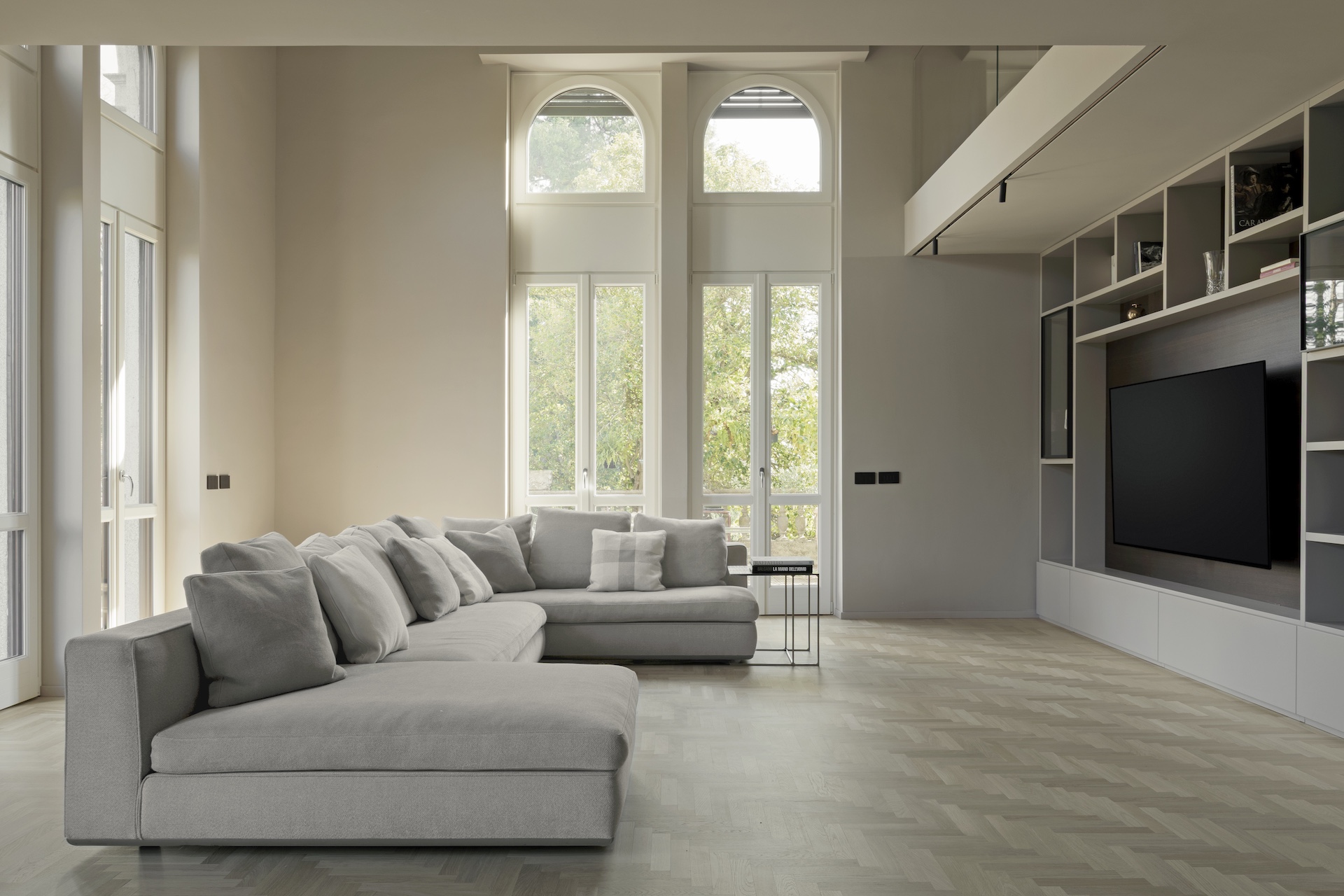
On the ground floor, the service spaces will be thinned out, with the creation of a large dining area adjacent to the main kitchen and the creation of a service kitchen. The large living room remains unchanged in terms of layout, but its characteristic double-height ceiling is expanded to cover half of the floor space. On the upper floor, the partial demolition of a portion of the attic of the study overlooking the living room below allows for a more clearly defined double-height space compared to the original triangular layout. A gallery, which extends into the corridor leading to the bedrooms on the floor, provides an interesting view of this void created by the double-height ceiling. The passage to the upper apartment, located on the second floor, is created above the existing staircase. The second-floor apartment is modified with respect to the staircase, with the reduction of an existing bathroom; other minor modifications include the removal and modification of some internal paneling.
Windows and furnishings
The windows were replaced with ones of the same design but more efficient, featuring triple glazing, finished in walnut-stained wood on the outside and white on the inside. As for the furnishings, the large living room bookcase—which extends vertically on the first floor, organizing the double-height space—continues toward the kitchen, blending into the wall unit. The living room is enhanced by an architectural feature, marked by a glossy finish and targeted lighting, which encompasses part of the space, defining a more intimate area designed to accommodate a relaxation area, separate from the living area, for conversation or reading. The kitchen, the true heart of the home, is structured around a large island that dominates the space and is embellished with ceilings of varying heights and hidden lights that make the artificial lighting particularly delicate yet efficient. Completing this space are a “refectory” table, a favorite of the clients, decorative lights on the table and island, and, most importantly, a service kitchen accessed through a passageway within the wall unit. The service bathroom is also accessed through a similar opening.
Materials and surfaces
As is Studio Ecoarch’s philosophy, the materials are few, natural, and carefully selected: the oak flooring, the walls and ceilings painted in the same color with a few touches of darker hues to emphasize certain spaces (the relaxation area within the living room, the staircase, the bathrooms, the first-floor corridor) and the changing architectural relationships. For the bathroom cladding, we opted for a microcement finish combined with large-format tiles, while for the new staircase, we continued with oak, differentiating it from the existing Carrara marble-clad one, which we preserved as a reminder of the past.
Anno: 2022
Cliente: Private
Stato: Completed
Luogo: Milano
Photos: Marco Reggi